
Jazz Piano Fundamentals — The Essential Guide

This guide covers the essential building blocks every jazz pianist needs to master.
You’ll learn how to count intervals, build 7th chords, play ii–V–I progressions, and use simple arranging techniques that make your playing sound more advanced.
Jump to:
Count intervals →
Build 7th chords →
Master ii–V–I progressions →
Beginner arranging techniques →
Step 1: Master Intervals (The Foundation of Jazz Piano)
The very first skill every jazz pianist must master is interval counting. Every chord, voicing, and progression in jazz is really just an interval pattern.

The Most Important Intervals for Beginners
• Half step – smallest movement on piano
• Whole step – two half steps
• Minor third
• Major third
• Perfect fourth
• Tritone
• Perfect fifth
These intervals are enough to build nearly every jazz chord you’ll encounter as a beginner.
Why the Perfect Fifth Matters Most
If you only learn one interval first, learn the perfect fifth.
• C → G
• G → D
• D → A
• A → E
• E → B
• B → F♯
• F♯ → C♯
• C♯ → G♯
• G♯ → D♯
• D♯ → A♯
• A♯ → F
• F → C
Thirds: How Jazz Chords Are Built
Jazz chords are stacked in thirds:
• Major third = two whole steps
• Minor third = whole step + half step
Quick Tips
• Fourths = reversed fifths
• Tritone = three whole steps
• Minor 7th = octave down whole step
• Major 7th = octave down half step
Step 2: Build All Essential 7th Chords
Almost every jazz tune uses combinations of just four chord types.
Major 7 Chord
Example: Cmaj7 = C E G B
• Major third
• Minor third
• Major third
Minor 7 Chord
Example: Cm7 = C Eb G Bb
• Minor third
• Major third
• Minor third
Dominant 7 Chord
Example: C7 = C E G Bb
• Major third
• Minor third
• Minor third
Half-Diminished Chord
Example: Cø7 = C Eb Gb Bb
• Minor third
• Minor third
• Major third
Step 3: Master ii–V–I Progressions in All 12 Keys
The ii–V–I progression is the backbone of jazz.
In C major:
• ii = Dm7
• V = G7
• I = Cmaj7
Recognizing ii–V–I Quickly
• Minor 7 chord
• Up a fourth to dominant 7
• Down a fifth to major 7
Simple Beginner Voicing
- Play ii chord
- Move minimally to V chord
- Resolve to I chord
Minor ii–V–I Basics
• ii = half-diminished
• V = dominant
• I = minor
Step 4: Beginner Arranging Techniques (Sound Advanced Fast)
These techniques are beginner-friendly, but they instantly make your playing sound richer, more professional, and more authentic.
1. Shell Voicings
One of the most important beginner arranging tools is the shell voicing.
A shell voicing uses:
• Root (left hand)
• 3rd + 7th (right hand)
For example:
Cmaj7:
• Left hand: C
• Right hand: E + B
This gives you the essential harmonic structure of the chord while keeping your playing clean and practical.
There are two shell positions:
• Position A = 3rd + 7th
• Position B = 7th + 3rd
Shell voicings are especially useful when the melody note is either the chord’s 3rd or 7th.
This allows you to harmonize melody naturally while sounding sophisticated.
2. Root–Fifth Left Hand Movement
When a chord lasts for multiple beats, don’t just sit on the root.
Instead your left hand can play:
• Root → Fifth
• Root → Fifth → Root
• Root → Fifth → Root → Fifth
This creates bass movement and variety.
Example:
For Cmaj7 – play C → G
This simple trick instantly adds motion.
3. Add ♭9 to Dominant 7 Chords
One of the fastest ways to sound more advanced.
To find the flat 9:
Count up one half step from the root.
Examples:
C7 → D♭
F7 → G♭
B♭7 → B natural
This creates stronger Jazz tension and richer harmonic color.
Use this especially in:
• V7 chords
• Turnarounds
• Ballads
• Standard endings
4. Ripple Chords
Rippling means rolling the notes of a larger chord upward instead of playing them all simultaneously.
Best used when you have 5 or more notes in your chord voicing.
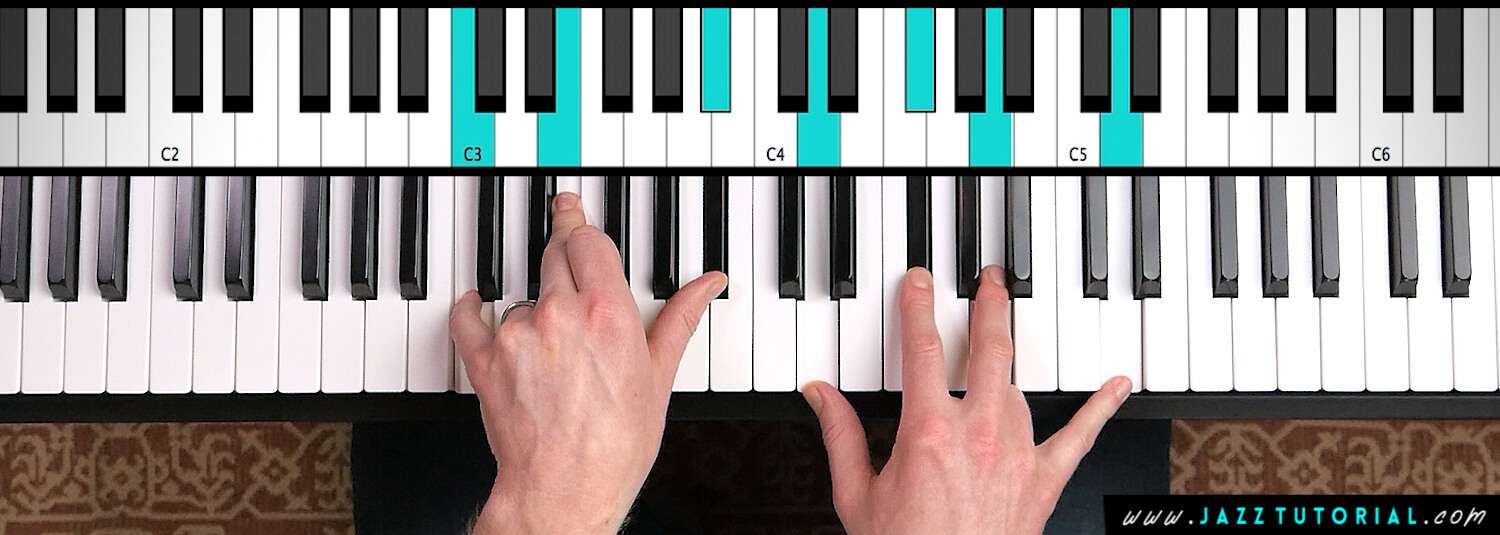
It works especially well in ballads – like Misty, Tenderly, or Cry Me A River.
Want to fully master Jazz piano chord voicings? Explore my complete Jazz Piano Chord Voicing lesson: Master Jazz Chord Voicings →
5. Simple Jazz Endings
Major Song Ending:
For major songs, end with:
• Root + Fifth
• 3rd + 7th repeated
This gives a polished classic Jazz resolution.
Advanced variation:
Use a half-step-above major chord before resolving.
Example:
D♭maj7 → Cmaj7
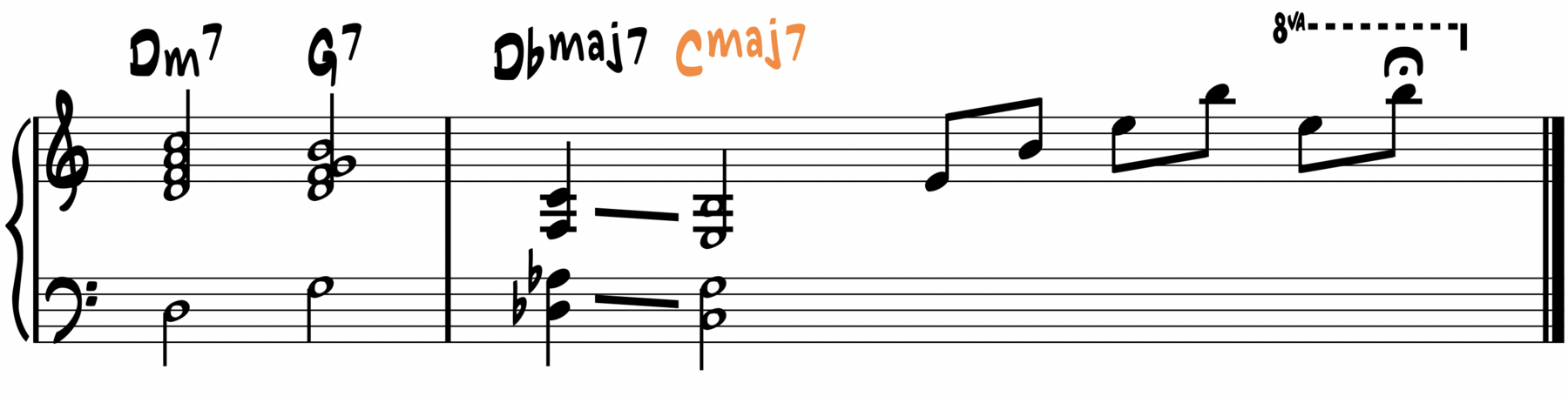
This creates a more sophisticated final cadence.
Minor Song Ending:
For minor songs:
Use a minor 6 arpeggio upward.
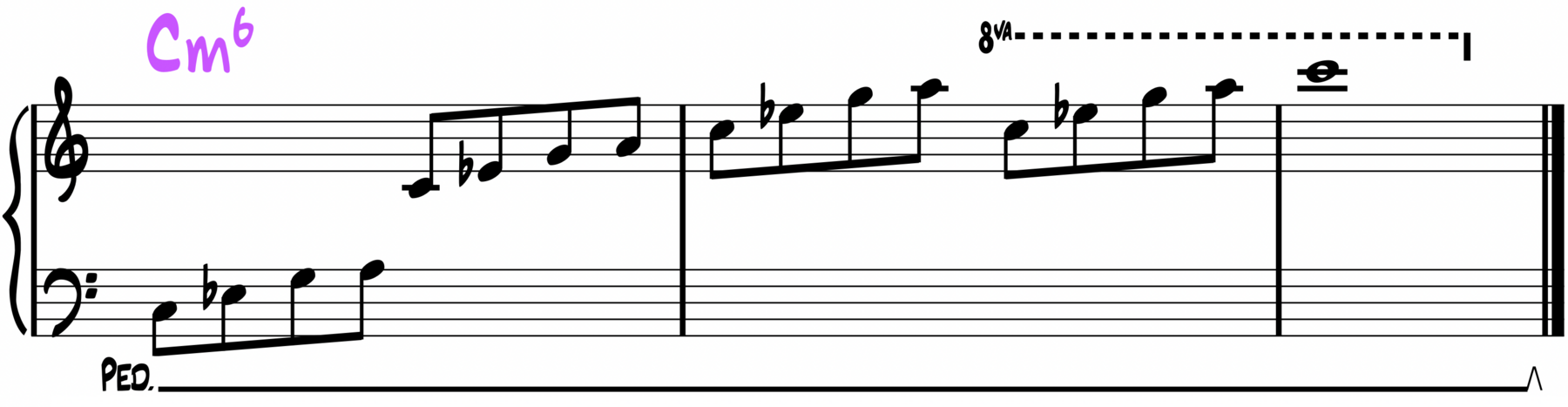
This creates a beautiful traditional minor Jazz ending.
Next Step
Want to understand the theory behind the songs in your Real Book?
Jazz Theory Explained teaches you jazz chords, progressions, scales, voicings, and improvisation in one concise, 100-page guide.
Fill in the gaps. Connect the dots.
Digital PDF · Instant Download · Print at Home · 90 Days Risk-Free
“Within 5 minutes I knew that it was exactly what I’d been looking for for years.” — Steve Schneider, USA