
Piano Intervals Explained: Interval Counting for Jazz Piano Beginners
Prefer to watch? Here's my complete guide to learning Jazz piano:
If you don’t understand intervals, everything in jazz piano feels harder than it should.
Chords don’t make sense. Scales feel disconnected. Improvisation feels like guessing.
That’s because intervals are the foundation of everything.
In this lesson, I’ll show you a simple way to count intervals on the piano—so you can finally understand how music is put together, from the ground up.
How long does it take you to answer the following questions?
-
"What's a tritone up from D?"
-
"What's a 5th up from Bb?"
-
"What's a minor 7th up from F#?"
-
"What's a major 3rd up from Ab?"
If it takes you more than three seconds (each one) - there's something you need to work on...
Before you do anything else...
I call it 'interval arithmetic'.
It means to count intervals - up from any note.
Key Point:
To learn Jazz harmony (or any type of harmony) - you first have to memorize all of the intervals.
It's the first step.
Count all 12 intervals (half-step, whole-step, min 3rd, etc)...
From all 12 notes (C, C#, D, Eb, E, etc).
"Why is this important?"
Because everything you do in Jazz requires you to count intervals:
To play an F minor 6 chord - you have to count out the intervals:
Start on F, + min 3rd + maj 3rd + whole-step...
= F Ab C D.
Or to play a D minor 7 b5 chord - you have to count out the intervals:
Start on D, + min 3rd + min 3rd + maj 3rd...
= D F Ab C.
Or to play a C minor 11 chord - you have to count out the intervals:
Start on C, + min 3rd + maj 3rd + min 3rd + maj 3rd + min 3rd...
= C Eb G Bb D F.
Chord Voicings
The same goes for chord voicings.
Every chord voicing is an interval pattern...
Which you can build from any of the 12 notes.
The following chord voicing is a 'Kenny Barron voicing' for A minor 11.
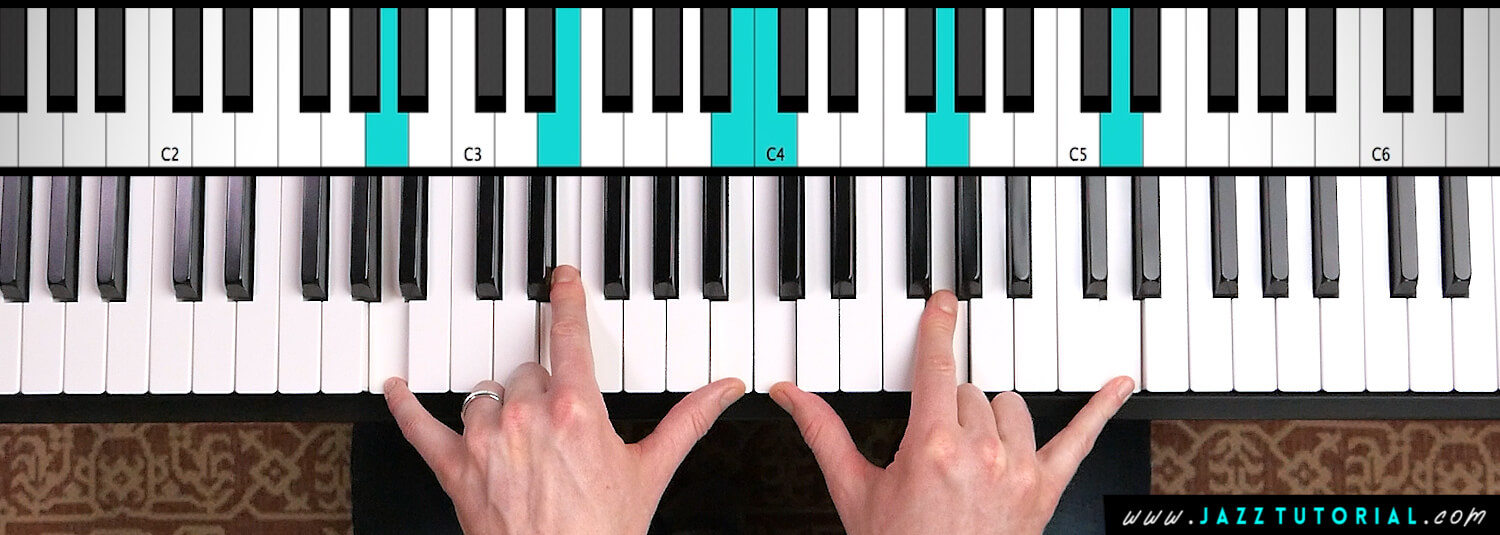
I do NOT think of this chord as "A + E + B + C + G + D".
Instead I think of it as "root (A) + 5th + 5th + half-step + 5th + 5th".
Jazz scales
The same goes for Jazz scales.
Every scale is an interval pattern...
(Usually whole-steps and half-steps)...
You must first learn the scale as an interval pattern...
And then you can build that interval pattern from any of the 12 notes.
Key Point:
As a Jazz pianist, you are constantly counting intervals.
All day long.
More than anything else you do.
When you play from a Real Book, each chord symbol requires you to count out intervals.
Start on the chord's root note...
Then build an interval pattern upwards (for the voicing you want to play).
Most Jazz students are SLOW at interval counting.
How can I tell?
There's a clear sign:
When you're getting ready to play the next chord, you're supposed to jump straight to the notes in a flash...
But instead, your fingers get stuck hovering above the notes - each finger adjusting itself up, or down...
While you check if you have the right notes or not.
I can hear you thinking "Is that right? No - down a half-step. Or actually... up? No down. What about the next note..."
This to me is a clear sign - that you are not fast enough at counting intervals.
Today's challenge:
Memorize all 12 intervals...
Counting from all 12 notes.
This is your #1 goal.
I've typed up the answers and put them in one simple document.
Print this out and learn it (spend the next 1-2 months learning this).
Ready to begin? Here it is:
P.S. Answers:
-
"What's a tritone up from D?" = Ab
-
"What's a 5th up from Bb?" = F
-
"What's a minor 7th up from F#?" = E
-
"What's a major 3rd up from Ab?" = C
Next step
Want to learn jazz piano properly from the ground up?
Intervals are just the beginning. In my full beginner jazz piano guide, I show you how intervals connect to chords, scales, ii–V–I progressions, and improvisation — so the whole system finally makes sense.