
Jazz Piano Chord Voicings (What They Are & How They Work)

A chord voicing in jazz piano refers to the specific way a chord is arranged and played on the keyboard. Instead of playing all chords in root position, jazz pianists use different voicings such as shell voicings, rootless voicings, open voicings, and stacked interval voicings to create smoother voice leading, richer harmony, and a more professional jazz sound.
Chord voicings do not change the chord itself — they change how the chord is distributed across the hands and registers of the piano.
Watch this 4-minute lesson:
🎹 Download → Free Jazz Piano Chord Voicing Pack
What Are Jazz Piano Chord Voicings?
A chord voicing is simply a way of playing a chord on the piano.
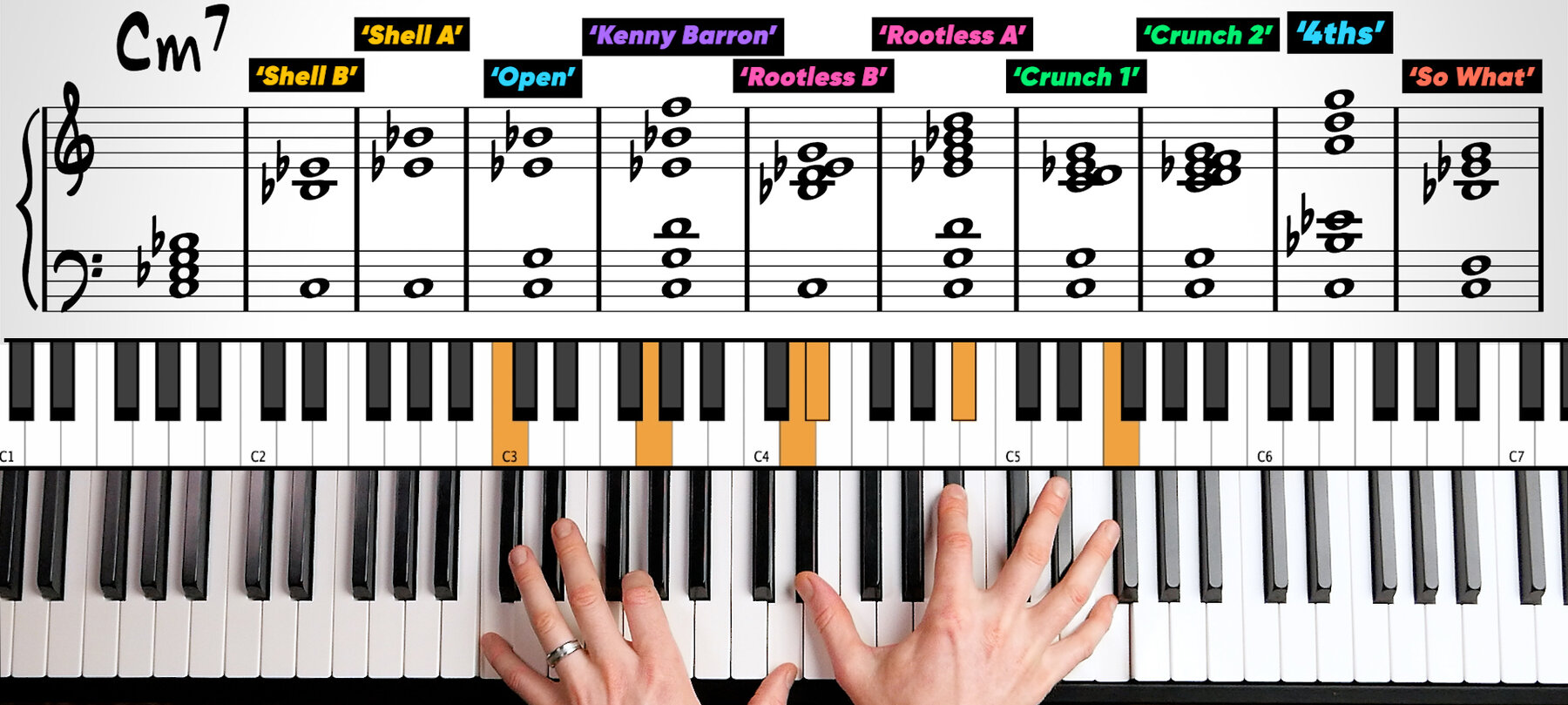
For example, a C minor 7 chord can be played in many different ways:
• Root position
• Shell voicing
• Rootless voicing
• Open voicing
• Fourth-based voicing
• “So What” voicing
• Kenny Barron style voicing
All of these are still a C minor 7 chord — but they sound completely different depending on how the notes are arranged.
Why Jazz Uses Different Voicings
If you only play chords in root position, your hand has to jump around the keyboard and the sound becomes heavy and amateur.
Jazz piano avoids this by spreading notes across both hands and different registers.
This creates:
• Smoother voice leading
• More space in the harmony
• A professional “recorded jazz” sound
• Easier movement between chords
Shell Voicings (The Foundation)
Shell voicings are the simplest jazz voicings.
They use:
• Root (left hand)
• 3rd and 7th (right hand)
For example, C minor 7:
• Left hand: C
• Right hand: E♭ – B♭
You can also invert these into different positions (Position A and Position B) to create movement and flexibility.
Shell voicings are used in:
• Beginner jazz piano
• Comping behind melodies
• Early ii–V–I practice
Rootless Voicings (Essential Jazz Sound)
Rootless voicings remove the root from the right hand and focus on the 3rd, 5th, 7th, and extensions.
For example:
A C major 7 rootless voicing might be built from E minor 7.
A C minor 7 rootless voicing can be built from E♭ major 7.
This creates:
• A fuller, more modern jazz sound
• Less clutter in the low end
• Better interaction with bass players
Rootless voicings are a core part of professional jazz piano.
Kenny Barron Voicings (Stacked Fifths)
Kenny Barron style voicings are built from stacked fifths.
They use:
• Perfect fifth intervals in both hands
• Built from the chord’s 3rd
• Often expanded with extensions like the 9th
These voicings create:
• Wide harmonic spacing
• Open, modern jazz sound
• Smooth harmonic motion
If you cannot reach all notes, you can arpeggiate them while holding the pedal.
So What Voicings (Quartal Harmony)
So What voicings are built from stacked fourths.
They are commonly used in modal jazz.
For example, a D minor 7 voicing:
• D – G – C – F
These voicings sound:
• Modern
• Open
• Slightly ambiguous
They are especially common in modal jazz and Miles Davis style harmony.
Open Voicings and Crunch Voicings
Open voicings spread notes across wide intervals to create space.
Crunch voicings compress notes closer together to create tension and density.
Both are used depending on musical context:
• Open = spacious, lyrical
• Crunch = tension, intensity
How to Choose the Right Voicings
A powerful way to choose voicings is to look at the melody note.
Then choose a chord voicing that already contains the melody as the top note.
For example:
If the melody note is the 9th, choose a rootless voicing that places the 9th on top:
C – Eb – G – Bb – D
Or if the melody note is the 5th, choose a shell or voicing that naturally supports it.
C – Bb – D Eb – G
To voice a song, slowly work through its chords – one at a time – and choose each voicing so that it matches the melody note – like this:
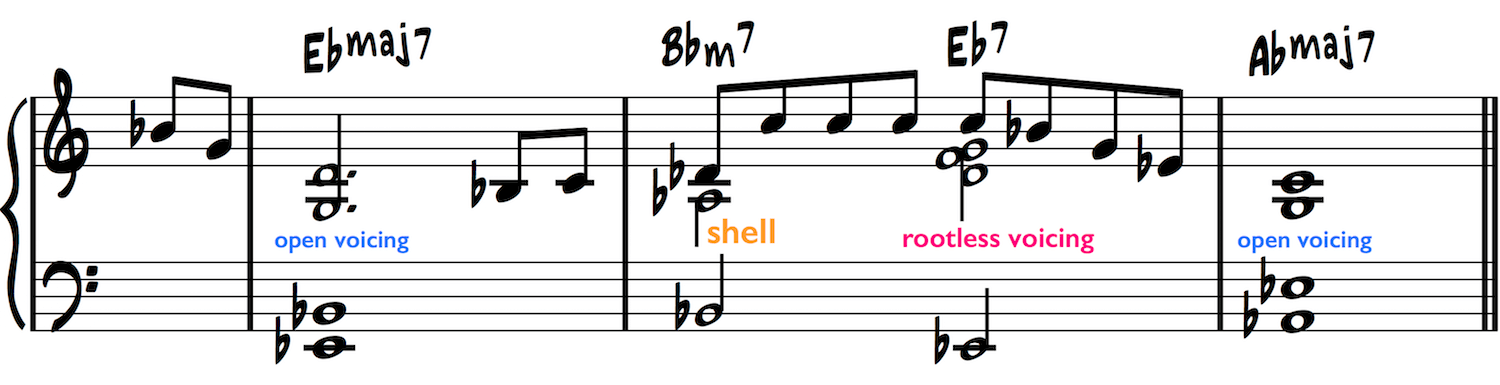
If you do this – you'll have:
• No redundant notes
• No unexpected clashes (between chord voicing and melody)
• Professional sound throughout
• Works every time – no guesswork
Why Voicings Matter
Chord voicings are what transform basic chords into real jazz piano.
They determine:
• Sound quality
• Style (modern vs traditional)
• Smoothness of progression
• How professional your playing feels
Once you understand voicings, you stop thinking in “chords” and start thinking in sound design.
Next Step
For a deeper look at shell voicings, rootless voicings, open voicings, Kenny Barron voicings, voice leading, and how to choose the right voicing in real songs:
→ Complete Jazz Piano Chord Voicing Guide
Free Chord Voicings Guide
Want a printable reference of the most important jazz voicings?
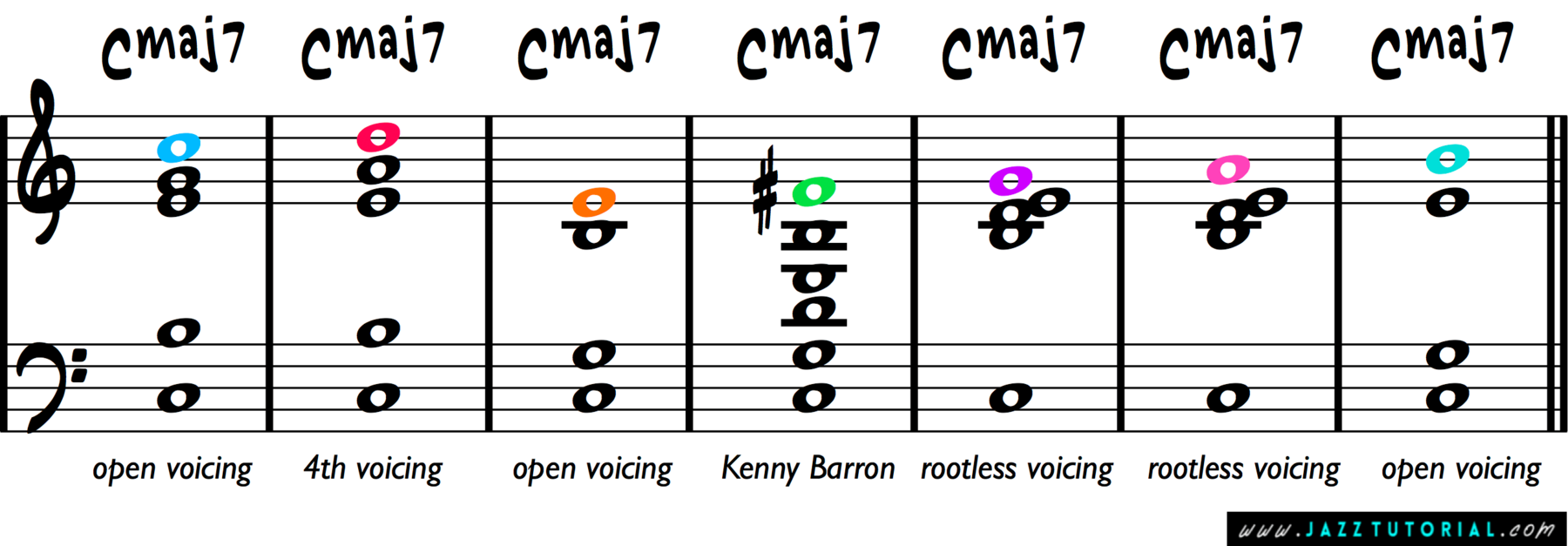
This guide shows essential shell voicings, rootless voicings, and modern jazz piano shapes you can use immediately.