
Jazz Piano Minor 11 Voicings: Kenny Barron Style Explained

If you want your jazz piano playing to sound professional, chord voicings are everything.
This is where most players get stuck.
They learn chords… but their playing still sounds basic, thin, or mechanical.
The difference comes down to how you voice those chords—and that’s exactly what we’re going to fix in this lesson.
Here, you’ll learn a powerful minor 11 voicing in the style of Kenny Barron—along with variations you can actually use in real playing. These are rich, modern sounds used by top jazz pianists, and once you understand them, they immediately upgrade your sound.
But one important thing to understand…
Chord voicings are just one piece of the puzzle.
If you want to see how voicings fit into the bigger picture—how chords, scales, ii–V–I progressions, and improvisation all connect—start here first:
👉 Learn Jazz Piano from the Ground Up →
In this guide, we’ll explore advanced jazz piano chord voicings for minor 11 chords and their variations to enhance your playing...
Minor 11 Chord Voicings:
The “Kenny Barron Voicing”
For C minor 11 voicing, we would play a stack of fifths in the left hand: the chord’s root, the fifth, and the ninth.
Then in your right hand, you’ll find the minor third, which is a half step up from the ninth, and build another stack of fifths in your right hand.
Left hand (stack of 5ths):
C – G – D
Right hand (from minor 3rd, stack of 5ths):
E♭ – B♭ – F
If you can stretch this, it’s really nice. If not, a few alternatives include arpeggiating it.
For example, in Kenny Barron’s song “Spiral,” it’s arpeggiated, so you don’t always have to play it as a block chord.
Or you can ripple it.
Major 7 Chord Variation
Now there’s also a major variation on the Kenny Barron voicing.
Basically, keep the left hand the same, but in the right hand, shift up a half step.
Instead of building from the minor third, build a stack of fifths from the major third instead.
This will give us the major seventh and the sharp 11 or the sharp four.
When it’s a major seven chord, I like to call this note the sharp four; it’s the same note as the sharp 11.
Left hand (same):
C – G – D
Right hand (from major 3rd, stack of 5ths):
E – B – F♯
It’s quite rare that you get to use this in a song. I use this most of the time for my compositions.
There are all sorts of neat patterns you can do where you just shift one of your hands up or down a half step.
So we can take C minor 11, slip the left hand down a half step, and you end up playing the major version of the voicing but built from B.
Then come back, and keep doing these patterns. B flat minor 11, slip the left hand down, so it’s nice patterns like this:
Left hand:
B – F♯ – C♯
Right hand (same as major variation):
E – B – F♯
Or you can shift the right hand up:
Left hand (original):
C – G – D
Right hand (up a half step from minor version):
E – B – F♯
“Sawn-Off” Variations
As with a lot of these big two-handed voicings, you can use what I call “sawn-off” variations of the voicings, where you don’t have to play up to the top notes.
Here we could actually saw it off and stop our voicing at the seventh.
Why would we do that?
If we had a minor seven chord and the melody note was the seventh of the chord, this would make a great voicing for C minor seven.
Left hand:
C – G – D
Right hand (cut at the 7th):
E♭ – B♭
We can do the same for the major seven variation; we don’t have to play up to the sharp four.
We could saw it off and just play the voicing like this: root, fifth, ninth, major third, and major seventh.
Left hand:
C – G – D
Right hand (cut at the 7th):
E – B
We could use this sawn-off variation at the beginning of “Misty.”
We start with this E flat major seven chord, and the melody lands on this D, which is the major seventh for E flat.
Which voicing can we play?
We can use the sawn-off variation of the major Kenny Barron voicing.
We have our stack of fifths in the left hand from the root, then we find the chord’s major third and play up one more fifth, and that is our voicing.
Left hand (stack of 5ths):
E♭ – B♭ – F
Right hand (major variation, sawn-off):
G – D
Summary
- Use stacks of fifths in both hands for rich C minor 11 voicings.
- Explore arpeggiating or rippling chords as alternatives to block chords.
- Shift half steps in either hand to create variations and patterns.
- Utilize “sawn-off” variations to simplify voicings and match melody notes.
- Experiment with major and minor voicing variations to fit different musical contexts.
Next Step
Want to understand the theory behind the songs in your Real Book?
Jazz Theory Explained teaches you jazz chords, progressions, scales, voicings, and improvisation in one concise, 100-page guide.
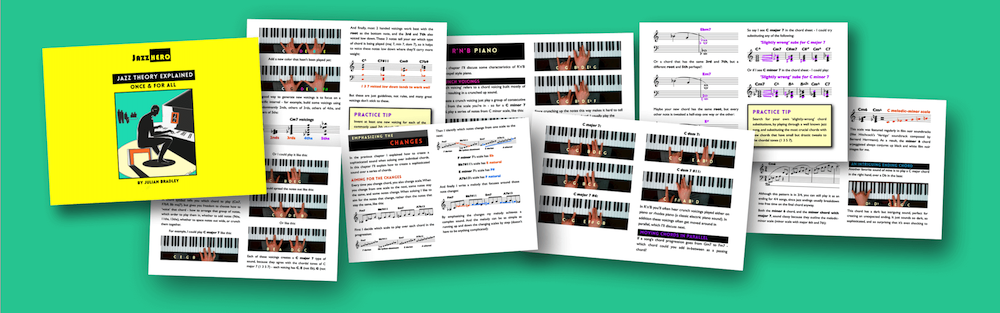
Fill in the gaps. Connect the dots.
Digital PDF · Instant Download · Print at Home · 90 Days Risk-Free
“Within 5 minutes I knew that it was exactly what I’d been looking for for years.” — Steve Schneider, USA