
Side Slipping in Jazz Piano: How to Use Chromatic Chord Shifts
Prefer to watch? Here's my complete guide to learning Jazz piano:

If you’ve ever listened to advanced jazz piano and wondered “what are they doing to make those chords sound so sophisticated and outside?”—side slipping is often part of the answer.
Side slipping is one of those techniques that sounds far more complex than it actually is. In reality, it’s a simple concept: you temporarily shift a chord up or down by a small interval, then return it to its original position. That small movement creates tension, color, and a sense of harmonic “motion” without changing the underlying harmony.
It’s used constantly in modal jazz, modern solo piano playing, and even subtle comping behind melodies. Pianists like Bill Evans helped popularize the sound, especially in tunes like So What, where parallel chord movement creates that floating, shifting harmonic feel.
In this lesson, you’ll learn exactly what side slipping is, how it works, and—most importantly—how to apply it in real jazz standards without overthinking theory.
What Is Side Slipping in Jazz Piano?
Side slipping is also sometimes called chromatic parallel chord movement, and it’s widely used in modern jazz harmony.
Here’s how it works:
Take any chord voicing—like this C minor 7 voicing:
C–Bb–D–Eb–G
Now transpose that entire voicing up or down by a step.
A visual way to think of it:
• Start with a full chord shape in one position
• Move the entire shape up a half-step or whole-step
• Then return to the original chord
Side-slipping usually sounds best when you move by a half-step or a whole-step (rather than larger intervals), and you can move in either direction—upwards or downwards.
You can even side-slip multiple times in a row:
• Moving further away from the original chord each time
• Or moving away and then immediately returning
For example:
• Cm7 → Bm7 → Bbm7
• Cm7 → Dm7 → Cm7
Examples of Side-Slipping
Side-slipping can be heard famously in So What by Miles Davis, where Bill Evans plays Em7 moving to Dm7 using parallel motion.
Instead of treating these as separate harmonic functions, the same voicing shape is shifted down by a whole step to create a floating, modal sound.
This creates the signature effect of side-slipping:
• Minimal harmonic change
• Maximum color and motion
• A smooth, modern jazz sound
When to Use Side-Slipping in Jazz Standards
When playing jazz standards from a Real Book, look for melodies that move stepwise and then return to their starting note.
For example:
• C → D → C
• C → B → C
When this happens, you can mirror that motion in the harmony by moving the chord in parallel with the melody:
• Cm7 → Dm7 → Cm7
• Cm7 → Bm7 → Cm7
Example 1: Cry Me A River
Watch me use side-slipping in my solo piano arrangement of 'Cry Me A River' (at 16 seconds):
In Cry Me A River (Arthur Hamilton), the melody plays:
• G → F# → G
Played over an Ebmaj7 chord.
You can reflect this movement by shifting the harmony:
• Ebmaj7 → Dmaj7 → Ebmaj7
The chord moves down a half-step with the melody and then returns, creating a subtle but expressive harmonic color.
Example 2: Taxi Driver Theme
Hear me 'side-slip' this D minor 11 chord – up a whole-step (E minor 11) and back:
In Bernard Herrmann’s Taxi Driver theme, a section of the melody moves:
• G → A → G
Over a Dm11 chord.
You can apply side-slipping by shifting the entire voicing:
• Dm11 → Em11 → Dm11
The harmony follows the melodic motion upward before resolving back.
In both cases, the result is a more fluid and sophisticated harmonic sound.
Want to learn Jazz piano chord progressions?
If you want to learn more jazz piano chord progressions, I’ve shared my best ones—including side-slipping and other essential techniques—here →
Jazz chord progressions for piano →
Chord Voicings for Side-Slipping
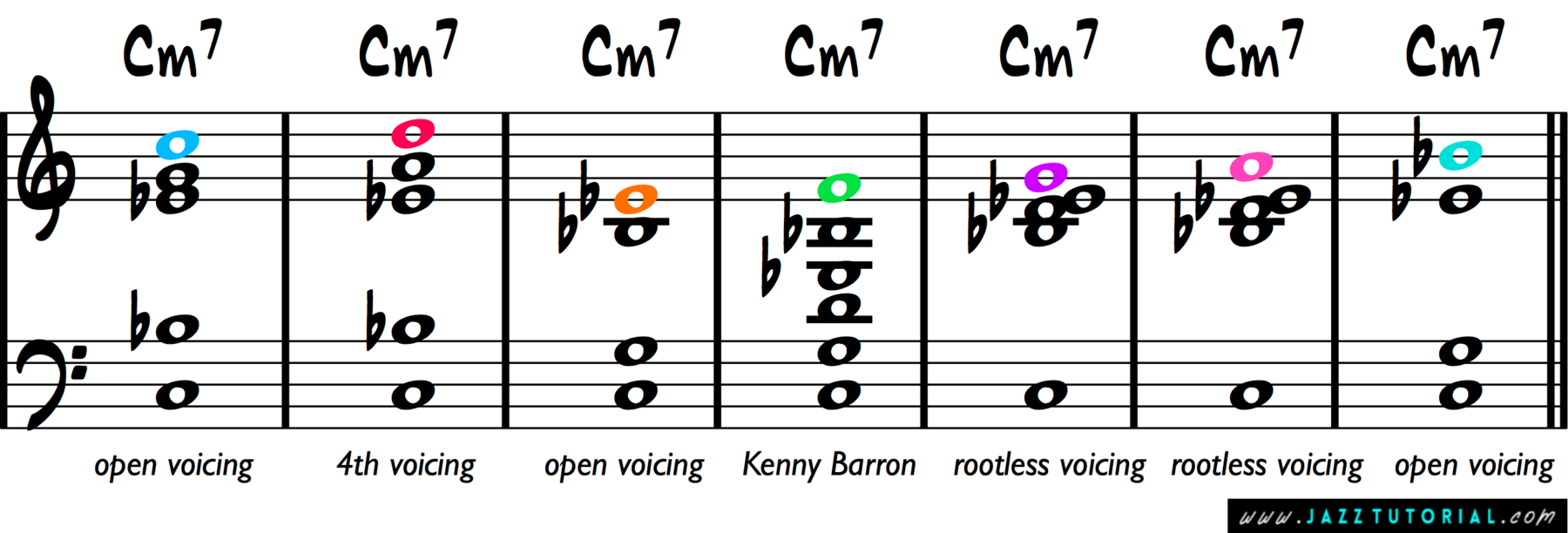
Side-slipping is most effective when applied to rich chord voicings (with many notes) – rather than simple 7th chords.
You can download my favorite Jazz piano chord voicings here (if you only learn one new chord voicing, it can change your whole sound instantly):
Chord voicings are the fastest win in jazz piano—they're easy to learn, easy to play.
One new voicing can transform your playing completely.
👉 Learn essential jazz piano chord voicings here →
Practice Tip
Go through your Real Book and look for melodies that follow this pattern:
• Start note
• Step away
• Step back
When you find this structure, try applying side-slipping by moving the chord in parallel with the melody.
Start slowly:
• One chord at a time
• Small movements only
• Focus on accuracy before speed
Next Step
Now that we've gone through the fundamentals, it’s time to apply them to real music.
👉 My complete Ultimate Guide to Jazz Piano shows you how chords, voicings, improvisation, standards, and theory all connect.
Continue to the Ultimate Guide →
I’m Julian Bradley, founder of Jazz Tutorial.
What you get here is one clear teaching philosophy — not a mix of conflicting approaches.
Simple. Structured. No confusion.