
The Pentatonic Scale in Jazz (and when to use it in Your Solos)
Today’s question is from Luciano:
“Hi Julian, I would like you to explain pentatonics on the triad alteration extensions…”
Hi Luciano! Let me explain the pentatonic scale and all the jazz chords you can play it on…
First - here are the notes of the pentatonic scale:
- C major pentatonic scale = C D E G A
There’s also a ‘minor pentatonic scale’ - which is the same 5 notes, just starting from A instead of C:
- A minor pentatonic scale = A C D E G A (same notes as C major pentatonic).
When playing jazz piano I find it easiest to think of the major pentatonic scale - rather than the minor version…
Make sure you learn the pentatonic scale by its interval pattern and not its notes:
The major pentatonic scale is mostly whole-steps: 1 - 2 - 3 (C - D - E) and 5 - 6 (G - A)…
And there’s two minor 3rd gaps - between 3 - 5 (E - G), and between 6 - 1 (A - C).
Free Resource: Download my '30 Beginner Jazz Songs' list.
Now let’s go through each chord:
Over C major 7 - there’s 3 pentatonic scales you can play:
-
C major pentatonic is the simplest option - C D E G A
-
G major pentatonic scale is more colorful - G A B D E
-
D major pentatonic scale is even more colorful - D E F# A B
So the more chord extensions you play (9 11 13), the more colorful your melodic lines will sound when played over the chord…
G pentatonic and D pentatonic scales have a nice balance of chord tones (1 3 5 7) as well as color (9 11 13).
Over C minor 7 - there’s also 3 pentatonic scales you can play:
-
Eb major pentatonic is the simplest option - Eb F G Bb C
-
Bb major pentatonic scale is more colorful - Bb C D F G
-
F major pentatonic scale is even more colorful - F G A C D
To remember these - just remember the scale degrees that each scale is built from: minor 3rd (Eb), minor 7th (Bb) and 4th (F).
And over C7 - there’s also 3 pentatonic scales you can play:
-
C major pentatonic has a simple sound - C D E G A (no altered extensions)
-
Bb major pentatonic scale is more colorful - Bb C D F G (creates a V7 sus 4 sound - playing F instead of E)
-
Gb major pentatonic scale is the most sophisticated option - Gb Ab Bb Db Eb (full of altered extensions - #11, b13, b9 and #9)…
Free Resource: Download my '30 Beginner Jazz Songs' list.
Simplified Thinking:
When you play a pentatonic scale over a chord - you’re still playing from a larger 7 note scale…
The chord’s notes in your left hand combined with the 5 notes in your right hand will reveal the full scale…
So when I play D pentatonic scale (D E F# A B) over C maj 7 (C E G B) - if you add those notes together you’ll see that I’m playing from C lydian scale:
- C lydian scale = C D E F# A B
Or when I play F pentatonic scale (F G A C D) over C min 7 (C Eb G Bb) - if you add those notes together you’ll see that I’m playing from C dorian scale:
- C dorian scale = C D Eb F A Bb
And one last example - when I play Gb pentatonic scale (Gb Ab Bb Db Eb) over C7 (C E Bb) - which scale am I really playing?
That’s right - those notes add up to C altered scale (you just have to remove the 5th from the C7 chord in this case):
- C altered scale = C Db Eb E Gb Ab Bb
So you can use pentatonic scales to simplify your thinking and also to direct your melody to 5 colorful notes…
The pentatonic scale is also a very memorable and singable interval pattern (90%+ of popular tunes are pentatonic) - so whatever you play, it will sound strong and melodic.
Next Step
Want to understand the theory behind the songs in your Real Book?
Jazz Theory Explained teaches you jazz chords, progressions, scales, voicings, and improvisation in one concise, 100-page guide.
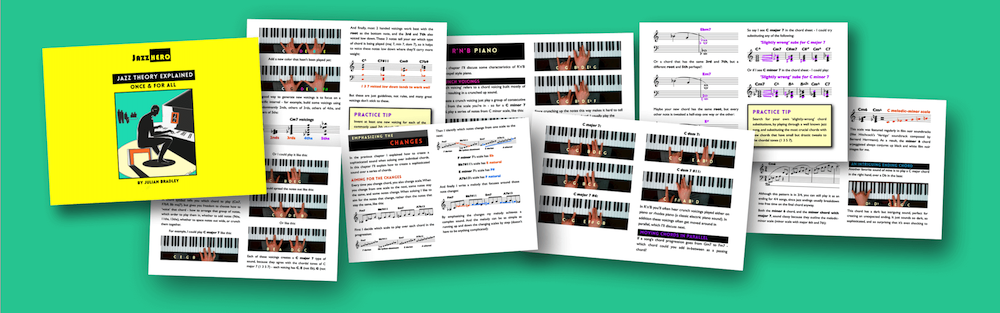
Fill in the gaps. Connect the dots.
Digital PDF · Instant Download · Print at Home · 90 Days Risk-Free
“Within 5 minutes I knew that it was exactly what I’d been looking for for years.” — Steve Schneider, USA