
The Simple Jazz Piano Method – Just 3 voicings, Hundreds of Songs
Chord voicings are already the fastest win in Jazz piano.
Easy to play. Instantly powerful.
But what if you didn’t need dozens of them?
What if just three voicings could unlock hundreds of songs?
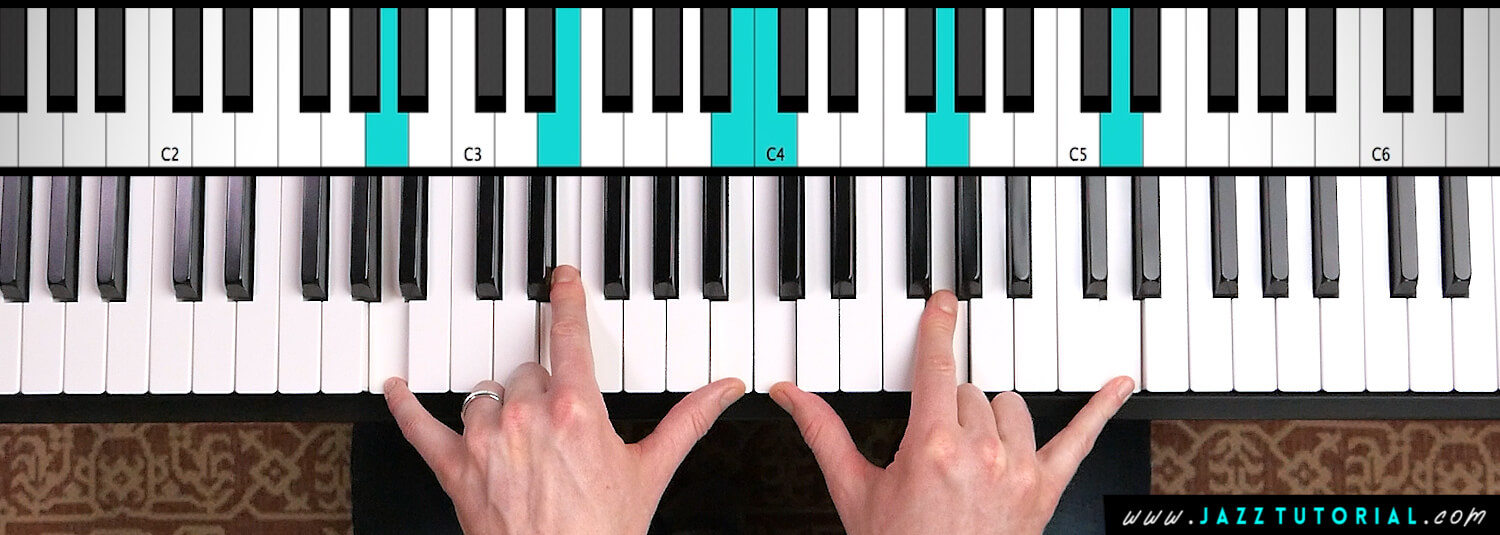
That’s exactly what I’m going to show you today:
A simple “three-voicing method.”
Just learn these three voicings...
And you'll be able to play hundreds of songs.
The "3-Voicing Method" – In a nutshell:
Literal voicings first (1–3–5–7).
When you don't have a better chord voicing in mind, just play the chord tones: 1–3–5–7.
This will cover about 60% of the chords you encounter.
Rootless voicings second.
Use for major 7 and minor 7 chords, but ONLY when the melody note is the 9th or the 5th of the chord.
The top note of your voicing = melody note.
Dominant 7 chords last.
For every V7 chord, add a flat 9.

That's the big picture. Now let's go into the details:
1. Literal voicings — start here
First learn to play 7th chords exactly as written:
Root, 3rd, 5th and 7th.
I call these 'literal voicings' — because they're exactly what the chord symbol says.
So if the chord symbol is 'C maj 7' — play C E G B.
If it's 'C min 7' — play C Eb G Bb.
And if it's 'C7' — play C E G Bb.
1 3 5 7 of the chord — that's it.
Much of your Jazz piano playing should be simple.
If you only play complex chords all of the time, the effect wears off fast...
Better to use plenty of simple voicings in your playing - so that you create CONTRAST next to the complex voicings (the simple voicings sound simple, the complex voicings sound complex).
60% of your chords will be literal voicings when using this method — 1 3 5 7.
2. Rootless voicings
Here's where the fun begins:
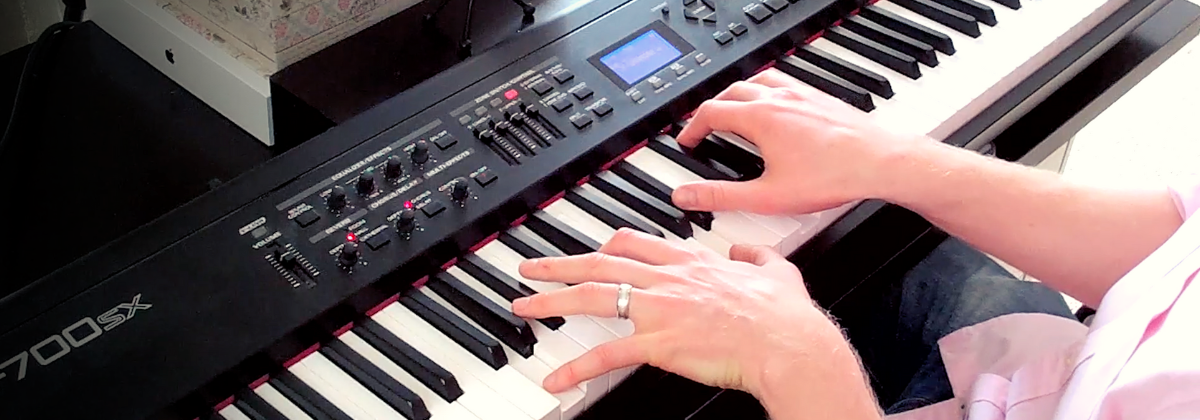
Use rootless voicings for major 7 and minor 7 chords — but ONLY when the melody note is the 9th or the 5th.
E.g. Chord symbol = 'C major 7'. Melody note = D (9th)...
You play: C + E G B D (E minor 7 over C).
Or if the melody note was a G (5th)...
You play: C + B D E G
"What are rootless voicings?"
For rootless voicings, you play the chord's 3rd–5th–7th–9th in your right hand, over the root in your left.
So for 'C major 7' — you play E minor 7 over C:
C + E–G–B–D
The top note is the 9th (D) — so all you have to do is play this voicing and you'll play both chord AND melody note (the 9th).
The same works for minor 7 chords:
For 'C minor 7' — you're going to play Eb major 7 over C:
C + Eb–G–Bb–D
Again, the top note is the 9th (D) — so use this to play both chord AND melody note together.
Rootless Voicings 'Position B'
In addition, you can invert the right-hand chords:
For C major 7, take the E minor 7 chord and play 7–9–3–5:
C + B–D–E–G
(Still E minor 7 in your right-hand but the notes are rearranged).
Now the top note is the 5th — which makes this an IDEAL voicing when the melody note is the 5th.
You can do the same for minor 7 chords – play is as b7–9–b3–5.
So 'C minor 7' = C + Bb–D–Eb–G
For a full explanation, watch my Rootless Voicings lesson:
Watch it here
3. Dominant 7 chords
Finally, here's how you voice dominant 7 chords.
Let's say you see 'C7' (C E G Bb):
Your left hand plays: Root + major 3rd + minor 7th (C–E–Bb).
Your right hand plays: Flat 9th (Db) – plus the melody note above.
Example: Chord symbol is C7 and the melody note is A.
You play: C E Bb in your left hand, Db + A in your right.
That's 1 3 7 in your left + b9 and melody note in your right.
(To find the flat 9, count up a half-step from the chord's root. So for C7, count up from C to Db).
You can watch me apply this technique to 'Misty' (flat 9th added to V7 chords):
Watch it here
Let's Review – 'The 3-Voicing Method'
Here are your three voicings and when to use them:
1. Literal voicings
When you don't have a better chord voicing in mind, just play the chord tones: 1–3–5–7.
This will cover about 60% of the chords you encounter.
2. Rootless voicings
Use when:
Chord = maj 7 or min 7
Melody note = 5th or 9th
- Melody note is the 9th? — play 3 5 7 9 in your right hand.
- Melody note is the 5th? — play 7 9 3 5 in your right hand.
(Left hand plays the root below).
3. Dominant 7 chords. For every V7 chord, add a flat 9.
Left hand: 1–3–7
Right hand: b9 + melody note.
This method gives you simple rules that work almost every time.
Your arrangements will have contrast and variety – and will sound professional.
Try This On a Real Song Today
Choose a song (I recommend Ballads):
- Misty
- Taxi Driver
- Cry Me A River
- Moon River
- My Funny Valentine
- Tenderly
- Georgia On My Mind
Print the song's lead sheet. Work through the chords slowly, one chord at a time – and write out your voicings using pencil.
Free Resource: Download my '30 Beginner Jazz Songs' list.
Ultimate Guide to Jazz Piano
Watch Next: Jazz chords, extensions, voicings, modulation, improvisation — finally explained simply.
Get the sheet music featured in this lesson sent to your inbox: