
The Ultimate Jazz Piano Guide: Chords, Voicings, Improvisation & Harmony
Watch the Ultimate Guide to Jazz Piano — complete walkthrough of jazz chords, ii–V–I progressions, improvisation techniques, and chord voicings.

Jazz piano can feel overwhelming because most players learn it in fragments.
They learn a few chords here, a few scales there, but never fully understand how jazz harmony actually fits together.
In this Ultimate Jazz Piano Guide, I’ll break down the full system behind jazz piano theory, chords, voicings, scales, improvisation and harmony — from beginner fundamentals to advanced professional concepts.
You’ll also learn how jazz standards, fake books, chord symbols and real-world jazz piano systems all connect.
If you want to properly understand Jazz piano from the ground up, this lesson will show you how everything fits together.
In this guide:
Intervals →
7th chords →
ii–V–I progression →
Chord extensions →
Altered chords →
Left-hand voicings →
Minor ii–V–I →
ii–V–I variations →
Jazz scales →
Improvisation →
Chord voicings →
Rootless voicings →
Kenny Barron voicings →
Upper structures →
Jazz standards →
Intervals in Jazz Piano
The first step to learning Jazz piano is learning intervals.
As a jazz pianist, you must be able to count all 12 intervals from all 12 notes quickly.
For example:
- Which note is a 5th above Db?
- Which note is a tritone above E?
- Which note is a minor 7th above F#?
Every chord, scale and voicing in jazz is built from interval patterns.
That means you must be able to construct chords, chord voicings, scales and harmony from any note.
Jazz piano is not about memorizing random shapes.
It’s about understanding how notes relate to each other.
If your interval counting is weak, every area of jazz becomes harder.
If you need to spend more time mastering jazz piano fundamentals properly, start here first:
Jazz Piano 7th Chords
Most jazz chords you see in a lead sheet will be 7th chords. Here are the main types:
In jazz, most chords are 7th chords.
This means instead of basic triads: 1 3 5
We usually build: 1 3 5 7
The three main types of 7th chord are:

- Major 7
- Minor 7
- Dominant 7
These three chord types make up the majority of jazz harmony.
A major 7 chord is a major triad plus a major 7th.
A minor 7 chord is a minor triad plus a minor 7th.
A dominant 7 chord is a major triad plus a minor 7th.
Your challenge is to learn all three chord types from all 12 notes.
You should be able to instantly build any major 7, minor 7 or dominant 7 chord quickly and accurately.
This level of fluency is foundational to jazz piano.
The ii–V–I Chord Progression
The ii–V–I is the most common chord progression in jazz. Every jazz song is built of this 3-chord progression:
Here's the ii-V-I in C major:

- ii = D minor 7, V = G7, I = C major 7
This creates: Minor 7 → Dominant 7 → Major 7
This ii-V-I pattern appears constantly throughout jazz standards.
Jazz songs are built by moving through connected harmonic key centers.
Jazz songs typically begin in a home key, move through a series of keys using ii–V–I progressions, then return home.
Sometimes you’ll see only partial versions:
- ii–V
- V–I
But the harmonic principle remains the same.
Your next major goal is to learn ii–V–I through all 12 keys.
This is one of the highest ROI practice systems in jazz piano.
Chord Extensions (9, 11, 13)
Jazz chords can go higher than 7ths. You can continue to build the stack of 3rds above the 7th - which gives you the 9th, 11th, and even 13th:
The numbers you see in chord symbols are usually odd numbers (7, 9, 11, 13). That's because chords are built in 3rds, so you start on the root and skip every other note:
1 - 3 - 5 - 7 - 9 - 11 - 13
So remember:
Chord tones are: Root, 3rd, 5th, 7th
Extensions are: 9th, 11th, 13th
These upper notes create the fuller sound associated with jazz piano.
Chord extensions are always measured from the major scale.
So for any C chord: 9th = D, 11th = F, 13th = A
This applies whether the chord is major, minor or dominant.
Once you understand this principle, chord extensions become dramatically easier.
Altered Chords (b9, #9, #11, b13)
Chord extensions can also be 'altered' – which means flattened or sharpened.
Common altered extensions include:
- Flat 9
- Sharp 9
- Sharp 11
- Flat 13
For example:
To play C7b9:
- Build C7, find natural 9th (D), then flatten it → Db
Always find the natural extension first, then alter it.
This keeps altered harmony much simpler.
Altered extensions are most common over dominant 7 chords and create tension, color and sophistication.
Jazz Piano Left Hand Voicings
Root position ii–V–I chords are clunky and inefficient.
Instead, jazz piano relies on smoother voice leading.
GET ii–V–I VOICINGS IN ALL 12 KEYS →
A common beginner-friendly system is:

- Play ii chord in root position, V chord in 2nd inversion, and I chord in root position
This minimizes hand movement, creates smoother harmony, and sounds more professional.
Your challenge is to master this voicing system through all 12 keys.
Once mastered, this becomes a major jazz piano milestone.
Minor ii–V–I Progressions
In addition to the major ii–V–I, jazz also uses a 'minor ii–V–I progression':
The minor ii-V-I is less common (roughly 10% of ii-V-Is are minor, while 90% are major).
The minor ii-V-I builds its three chords from the harmonic minor scale.
For example, in C minor:

- ii = D half diminished, V = G7, i = C minor-major 7
This creates a darker, more dramatic harmonic sound than the major ii–V–I.
However, in many practical jazz situations, the final chord is often simplified to a regular minor 7 chord for a more relaxed sound.
Minor ii–V–I progressions are essential because they appear regularly throughout jazz standards.
If you encounter half diminished chords or minor-major 7 chords, you are often dealing with minor key harmony.
Your goal should be to learn minor ii–V–I progressions through all 12 keys just as thoroughly as major ii–V–I progressions.
Common ii–V–I Variations
Jazz songs do not always present full ii–V–I progressions.
Sometimes composers use partial forms such as: ii–V or V–I
This means jazz harmony is often moving through temporary key centers without fully resolving.
Understanding these partial movements is extremely important.
It improves your:
- Song analysis
- Comping
- Improvisation
- Real book fluency
The better you understand harmonic function, the easier jazz standards become.
Jazz Piano Scales
Jazz scales are built directly from chord tones of the chord, plus extensions:
For every chord in jazz, there are multiple scale choices.
However, there is a simple formula that works almost every time:
Chord tones + whole step principle
Start with the chord tones: 1 3 5 7
Then add a whole step above the root, 3rd and 5th.
C major 7: C E G B + D F# A = C Lydian scale
C minor 7: C Eb G Bb + D F A = C Dorian scale
C7: C E G Bb + D F# A = C Lydian dominant scale
This system provides a practical shortcut for understanding jazz scales.
Rather than memorizing endless theory separately, you can build sophisticated scale choices directly from chord structure.
This makes improvisation much easier.
Jazz Piano Improvisation for Beginners
In jazz, it's common for a musician to play an improvised solo over the song's chord progression:
GET 29 JAZZ LICKS YOU CAN USE →
There are certain fundamental techniques that most jazz solos use.
The first major technique is chord tone soloing.
This means your improvisation focuses primarily on: Root, 3rd, 5th, 7th, 9th
This is the most standard technique for soloing over a song's chord progression. The possibilities are endless, and it always works.
The nice thing is it uses the same 'brain work' that your left hand is already doing. You're using the same notes in your right hand as your left hand.
A second major technique is the half-step below approach pattern.
This means approaching important chord tones from a half-step below before landing on them.
For example: C# → D, E → F, G# → A
This creates classic bebop movement.
A third major technique is using triplets.
Triplets create rhythmic sophistication and stronger jazz phrasing.
Additional improvisation principles include:
- Ending phrases on stable chord tones
- Switching octaves
- Practicing over ii–V–I progressions
- Internalizing jazz vocabulary
These systems provide a practical roadmap for beginner improvisation.
How to Practice Jazz Piano Improvisation
At this stage, your practice should focus on: Intervals, 7th chords, ii–V–I, Minor ii–V–I, Scales, Chord tone soloing, Jazz licks
The goal is complete fluency.
Jazz mastery comes from repeatedly building:
- Chords
- Progressions
- Scales
- Improvisation lines
Through all 12 keys.
This is how isolated fragments become a true jazz piano system.
If you’d like to go deeper into Jazz piano improvisation and master the core techniques step-by-step, start here:
Jazz Piano Improvisation Guide →
Jazz Piano Chord Voicings
A chord voicing is simply a way of playing a chord.
While chord symbols tell you the harmony, they do not tell you exactly which notes to play.
This means a single chord — such as C minor 7 — can be voiced many different ways.
For example:
- Shell voicings
- Rootless voicings
- Open voicings
- Kenny Barron voicings
- Quartal voicings
- So What voicings
- Upper structures
Learning chord voicings is how you move from basic theory into professional sounding Jazz piano.
Shell voicings
Shell voicings are the simplest type of chord voicing – you strip the chord down to its bare essentials:
GET SHELL VOICINGS SHEET MUSIC →
One of the first voicing systems to learn is shell voicings.
Shells simplify harmony by using: Root, 3rd, 7th
The benefit of shells:
-
Creates a simple sound, which contrasts nicely with your more complex voicings.
-
Gives maximum freedom to a soloist – if you're playing with other musicians – to play any scale they want over the chords.
Shell voicings are ideal for beginners, comping, learning standards and understanding voice leading.
Rootless Voicings
Rootless voicings are one of the most important professional jazz piano chord voicings:
GET ROOTLESS VOICINGS SHEET MUSIC →
Rather than playing the root, rootless voicings focus on: 3rd, 5th, 7th, Extensions
This creates richer harmony while leaving space for a bassist.
They are especially useful for:
- Jazz standards
- Professional comping
- Trio settings
- Solo piano
When practicing rootless voicings:
- Build them from all 12 notes
- Learn both inversions
- Practice through ii–V–I progressions
- Focus on minimal movement
This dramatically strengthens your harmonic fluency.
Kenny Barron Voicings
The 'Kenny Barron voicing' is a beautiful two-handed voicing for 11th chords:
GET FREE CHORD VOICINGS PACK →
This voicing is ideal (if you can stretch it) when you see a minor 7 chord and the melody note is the 11th.
For example:
Chord = C minor 7. Melody note = F.
You play: C + G + D (left hand), Eb + Bb + F (right hand).
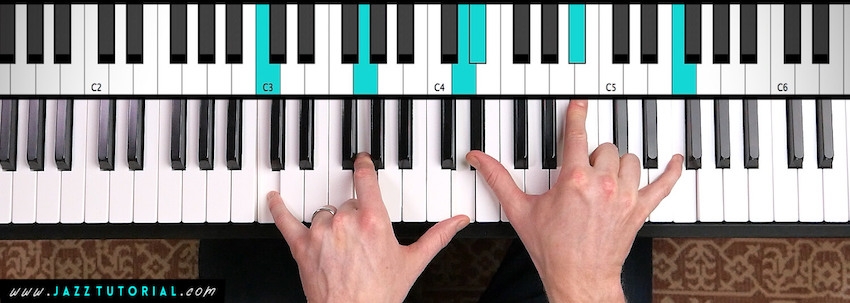
They are especially effective for ballads, modern jazz, solo piano and advanced comping.
If your hand cannot fully stretch certain voicings, rolling or arpeggiating them still produces excellent results.
How to Choose the Right Chord Voicing
With all these different types of chord voicing available, you need a method to decide which voicing to play:
One of the most practical professional strategies is melody matching.
Choose a chord voicing whose top note matches the melody note.
If the melody note is the 9th, choose a voicing that naturally places the 9th on top.
This creates:
- Better arrangements
- Cleaner solo piano playing
- Stronger harmonization
- More professional sounding comping
Rather than choosing voicings randomly, melody matching creates intentional harmony.
Upper Structure Triads
Upper structure voicings are a beautiful type of chord voicing for dominant 7 chords:
GET UPPER STRUCTURES SHEET MUSIC →
Here's how they work:
Left hand: Root, 3rd, 7th
Right hand: Major triads built above the chord
For example:
A C7 chord may use a D major triad in the right hand, creating: 9, #11, 13
Upper structures are one of the most efficient ways to create advanced dominant harmony.
They are widely used in modern jazz piano.
If you’d like to go deeper, I’ve created a complete in-depth Jazz piano chord voicings lesson dedicated entirely to choosing professional sounding voicings for any chord:
Complete Jazz Piano Chord Voicings Guide →
Beginner Jazz Standards to Learn First
When you first start learning jazz piano, it's important that you choose the right level of songs.
There are plenty of simple and easy jazz standards, that are ideal for beginners:
GET BEGINNER JAZZ SONGS LIST →
Recommended beginner standards include:
- Autumn Leaves
- Misty
- Tenderly
- All The Things You Are
- Afternoon in Paris
- Girl From Ipanema
- Bossa Nova standards
Your goal is mastery.
Play each song repeatedly until:
- Chords are memorized
- Melody is internalized
- Voicings become natural
- Improvisation feels connected
This is where theory becomes music.
Final Thoughts
Jazz piano can initially seem overwhelming because there are many moving parts:
- Intervals
- Chords
- Progressions
- Extensions
- Alterations
- Scales
- Improvisation
- Voicings
- Standards
But all of these elements connect into one coherent system.
Once you understand that system, jazz becomes dramatically clearer.
The goal is not to memorize isolated fragments.
The goal is to understand how everything fits together.
That is what creates true long-term jazz piano mastery.
Keep Learning
Beginner Jazz Piano Lesson
If you’d prefer a more beginner-friendly overview of Jazz piano first, start here:
Learn Jazz Piano: The Complete Beginner’s Guide →
Jazz Fundamentals Lesson
Or if you want me to personally walk you step-by-step through the first core milestones that make or break your success in Jazz piano — intervals, 7th chords and ii–V–I progressions — begin here:
Ear Training Lesson
One of the most important musical skills is learning how to play music by ear. In this guide, I’ll show you how ear training, chord progressions, and common musical patterns work together so you can start figuring songs out yourself.

I’m Julian Bradley, founder of Jazz Tutorial.
What you get here is one clear teaching philosophy — not a mix of conflicting approaches.
Simple. Structured. No confusion.