Tritone Substitution Explained (Jazz Piano Made Simple)
Prefer to watch? Here's my Tritone Substitution lesson:

Tritone substitution is one of the most powerful—and most misunderstood—reharmonization techniques in jazz piano.

At first glance, it can seem like you’re simply swapping one dominant 7 chord for another completely unrelated one. But in reality, there’s a very specific harmonic reason it works—and once you understand it, you can instantly start applying it to standards in a musical way.
In simple terms, tritone substitution allows you to replace a dominant 7 chord with another dominant 7 chord a tritone away, creating smoother bass movement, richer harmonic color, and a more modern jazz sound.
It’s one of those techniques that immediately makes your playing sound more advanced—but only if you understand when and why to use it, not just the theory behind it.
In this lesson, you’ll learn exactly what tritone substitution is, how it works in a 2-5-1 progression, why the harmony still functions the same way, and how to apply it in real jazz standards without breaking the music.
If you want to learn jazz piano properly from the ground up, I’ve put together a full guide that walks you through everything step by step—from chord types and voicings to scales and improvisation.
Watch my full guide →
Tritone Substitution Explained for Jazz Piano
Tritone substitution is one of the most useful reharmonization techniques in jazz.
If you’ve ever seen a dominant 7 chord replaced by another chord a tritone away — and wondered why it still works — this lesson will make it clear.
You’ll learn:
– what tritone substitution is
– how to use it on a 2-5-1
– why it works
– what scale to play over it
What is Tritone Substitution?
Tritone substitution is a reharmonization technique used often by jazz musicians.
“Reharmonization” means to change a song’s chords to something new.
Tritone substitution is one of the most common ways to do this.
How Tritone Substitution Works
Tritone substitution is applied to dominant 7 chords (C7, F7, Bb7, etc).
You take a V7 chord and move it up a tritone.
A tritone = 3 whole tones:
C → D → E → F#
So:
C7 → Gb7
By the way, the tritone is also called:
– augmented 4th (C → F#)
– diminished 5th (C → Gb)
Tritone Sub on the 2-5-1
Most dominant 7 chords appear in a 2-5-1 progression.
Example in C major:
Dm7 → G7 → Cmaj7
Apply tritone substitution:
Dm7 → Db7 → Cmaj7
Bass movement:
D → Db → C
This smooth half-step movement is what gives tritone substitution its sound.
Why Does Tritone Sub Work?
Compare these chords:
C7 = C E G Bb
Gb7 = Gb Bb Db E
Shared notes:
E and Bb
These are the 3rd and 7th — the most important notes in the chord.
So even though the root changes, the chord function stays the same.
The outer notes shift slightly:
C → Db
G → Gb
That’s where the altered sound comes from.
Chord Voicings for Tritone Substitution
Tritone substitution sounds best when you use rich chord voicings (with many notes) – rather than simple 7th chords.
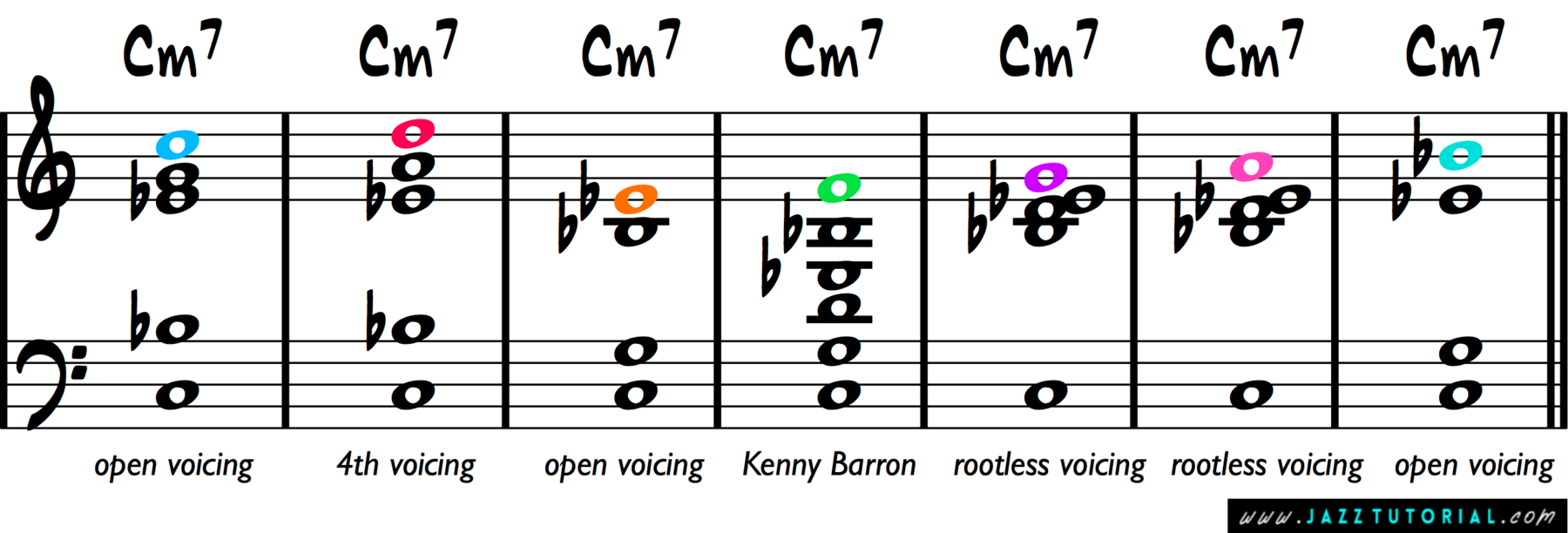
You can download my favorite Jazz piano chord voicings here:
Chord voicings are the fastest win in jazz piano—they're easy to learn, easy to play.
One new voicing can transform your playing completely.
👉 Learn essential jazz piano chord voicings here →
When You Change the Chord, You Change the Scale
When you substitute a chord, you often need a new scale.
A great option is the lydian dominant scale.
Example:
Dm7 → use C major
Db7 → use Db lydian dominant
Cmaj7 → use C major
Example scale:
Db lydian dominant = Db Eb F G Ab Bb Cb
Adjusting Melody Notes
If a note clashes, move it by a half-step.
Examples:
A → Ab or Bb
D → Db or Eb
You’re simply moving the note to the nearest “correct” note.
In most cases, flattening works well.
Practice Tip
Choose 3 songs from your Real Book:
- Find the V7 chords
- Replace them with tritone substitutions
- Adjust melody notes if needed
Recommended songs:
– Misty
– Cry Me A River
– Autumn Leaves
– Fly Me To The Moon
– Ladybird
Next step
If you’d like the full written version of my Ultimate Jazz Piano Guide — an encyclopedia-style lesson covering Jazz piano theory, chords, voicings, scales, improvisation and harmony — explore it here:
Or focus on one area:
Jazz Piano Fundamentals →
Chord Voicings →
Improvisation →
I’m Julian Bradley, founder of Jazz Tutorial.
What you get here is one clear teaching philosophy — not a mix of conflicting approaches.
Simple. Structured. No confusion.