
Learn Jazz Piano: The Complete Beginner’s Guide

Jazz piano can feel confusing at first.
Most players learn it in fragments without ever seeing how everything fits together.
In this guide, I’ll show you the core building blocks you need to understand jazz piano from the ground up.
In this guide:
Fake books →
Intervals →
7th chords →
Chord extensions →
Altered chords →
ii–V–I progression →
Left-hand voicings →
Minor ii–V–I →
ii–V–I variations →
Improvisation →
Jazz scales →
Jazz Piano Fake Books Explained (Real Books for Beginners)
To play Jazz piano you'll need two things:
A piano and a Fake book (also called a 'real book').
A Fake book is a collection of lead sheets to different jazz songs. However the notation will look slightly different to that of most western music (like classical music).
In Jazz, songs are notated using a single melody line in the treble clef (there’s no bass clef usually). Then chord symbols will be written above the melody line (most chords will end with a '7'):
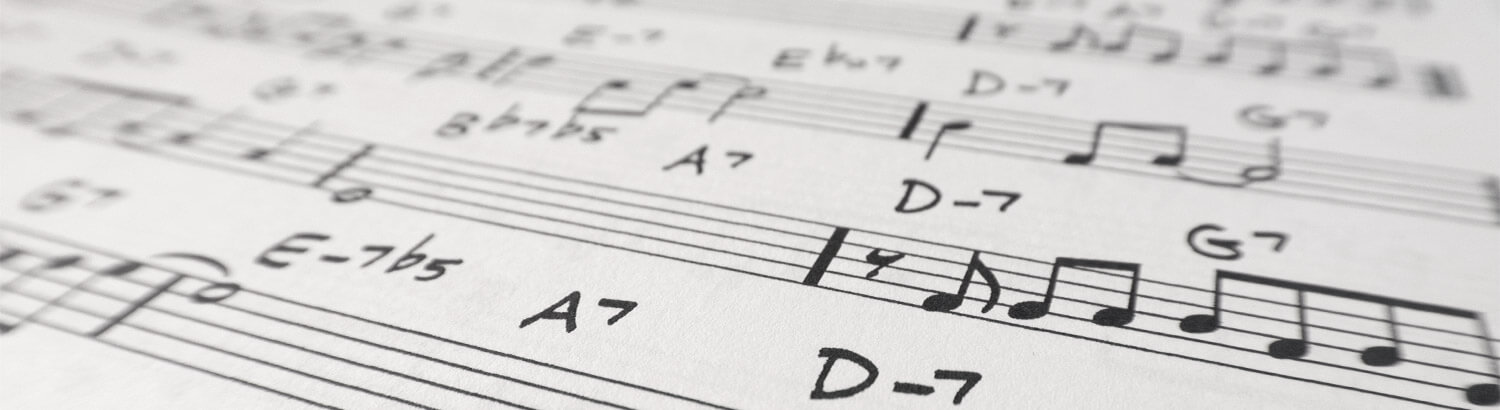
The Jazz pianist can ‘voice’ these chords in many different ways, so instead of telling you which chord voicings to play, chord symbols gives you the freedom to choose.
You’ll need to understand what all jazz piano chord symbols mean in order to play songs from a real book, and I’ll explain these in a moment.
Intervals in Jazz Piano (The Foundation You Must Learn First)
To learn Jazz, you first need to know how to count intervals...
'Interval' refers to the distance between any two notes.
For example the 'interval' between C and E is a 'major 3rd'.
The 'interval' between C and Eb is a 'minor 3rd'.
The 'interval' between C and G is a '5th'.
Or the 'interval' between C and B is a 'major 7th'.
And so on. There are 12 intervals that exist within the octave (half-step, whole-step, minor 3rd, major 3rd, 4th, tritone, 5th, minor 6th, major 6th, minor 7th, major 7th, and octave.
To start learning and playing Jazz piano, you need to be able to count any interval from any note.
Why?
Because every chord is an interval pattern (e.g. to play 'C minor 7' you have to count a minor 3rd + major 3rd + minor 3rd from C).
If you need to spend more time learning how to count intervals and understand the fundamentals properly, start with this lesson first:
Jazz Piano 7th Chords Explained (The 6 Essential Chord Types)
Now you’re ready to learn the different types of jazz chord. Most chords you see in your real book will be 7th chords - they have a ‘7’ on the end of them.
A '7th chord' is a normal major or minor triad (C E G) with a 7th added on top (B). So the chord is a stack of 3rds - it plays every other note from the scale:
E.g. Play C - skip D - play E - skip F - play G - skip A - play B.
Let's look at the three main types of 7th chord (which make up about 80% of jazz):
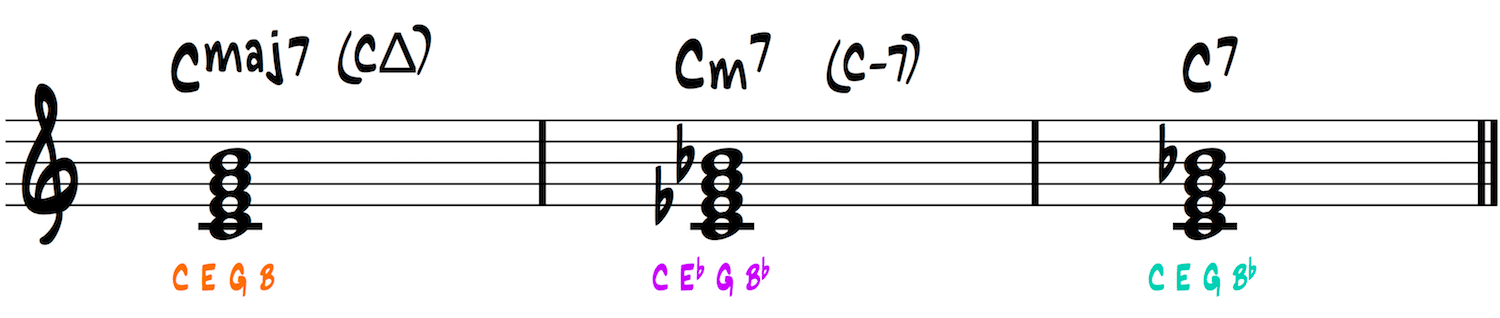
- C major 7 = C E G B (written as 'C maj 7' or 'CΔ') - 7th chord built from the major scale.
- C minor 7 = C Eb G Bb (written as 'C min 7' or 'C-7') - 7th chord built from the minor scale.
- C dominant 7 = C E G Bb (written as 'C7') - major chord with a minor 7th on top.
That leaves us with three remaining 7th chords (less commonly used):
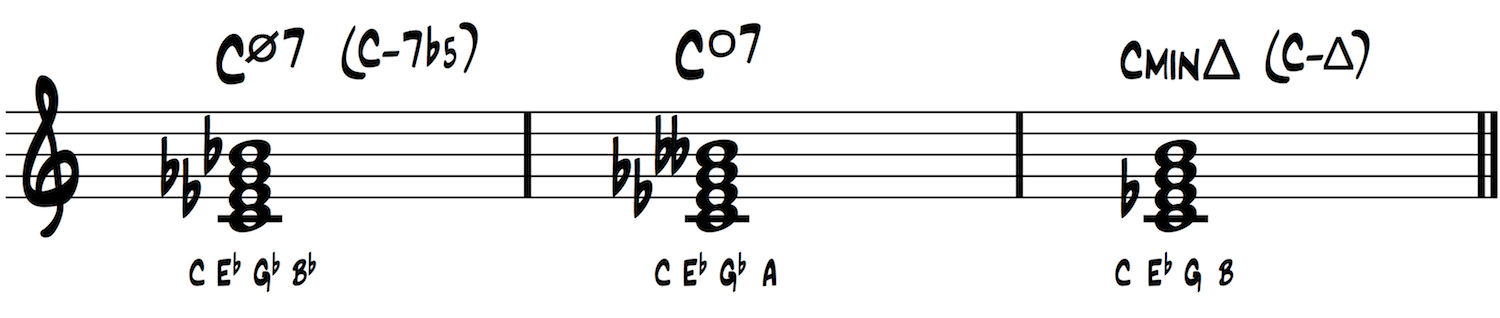
- C half-diminished (aka ‘C minor 7 flat 5’) = C Eb Gb Bb (written as 'Cø', 'C min 7 b5', or 'C-7b5') - diminished triad with a minor 7th.
- C diminished 7 = C Eb Gb Bbb (written as 'Cº7') - a complete stack of minor 3rds.
- C minor-major 7 = C Eb G B (written as 'C minΔ' or 'C-Δ') - minor chord with a major 7th on top.
PRACTICE TIP: Play all six 7th chords from each of the 12 notes on the piano. Make sure you count the interval pattern carefully for each note. Do not try to remember these by their note names - always count the intervals.

Jazz Chord Extensions Explained (9ths, 11ths, 13ths)
Jazz chords are built in 3rds, and we can continue building this stack of 3rds beyond the 7th:
1 - 3 - 5 - 7 - 9 - 11 - 13
The 9th, 11th, and 13th are called ‘chord extensions’. Some chord symbols will tell you to add a chord extension - by using the number ‘9’, ‘11’, or ‘13’. For example 'C min 11', or 'F7#11'.
But as a jazz pianist, you can add your own chord extensions to any chord - even when the lead sheet doesn't tell you to.
Chord extensions are always built from the major scale - regardless of what type of chord it is (even if it’s a minor 7 chord).
So for any type of C chord (C maj 7, C min 7, C7, etc) - if you want to add a 9th, or 11th, or 13th, just run up the notes of C major scale until you find your chord extension (C D E F G A B):
- The 9th is the same note as the 2nd = D.
- The 11th is the same note as the 4th = F.
- And the 13th is the same note as the 6th = A.
To find the correct chord extension, you must be able to build the major scale from any note.
Altered Jazz Chords Explained (♭9, #9, #11, ♭13)
Any chord extension can be ‘altered’ - which means flattened or sharpened (e.g. 'b9', '#9', '#11', 'b13').
When a chord symbol tells you to add an altered extension, start by finding the natural extension first. Do this by running up the major scale to find your natural extension. Then - flatten or sharpen it (whichever it tells you to do).
So to play an E7#11 - first build the 7th chord (E G# B D). Then run up the notes of E major scale to find the natural 11th (same note as the 4th) - E F# G# A, and finally, sharpen the 11th (A) = A#:
E - G# - B - D + A#
That’s it - chord extensions explained!
The ii–V–I Chord Progression Explained (The Most Important Pattern in Jazz)
Every style of music has its own characteristic chord progressions. In jazz, the most common chord progression is called the ‘2-5-1’ - commonly written as ‘ii-V-I’ (using Roman numerals).
The ii-V-I is a three-chord progression, and the numbers ‘2 5 1’ refer to which note in the scale the chord is built from.
Let’s look at the ii-V-I chord progression in the key of C major:

Each chord in the ii-V-I is a 7th chord (1 3 5 7), and is built from the notes of C major scale.
So the ii chord will be D F A C - that makes a D minor 7 chord.
The V chord will be G B D F - that’s a G7 chord.
And the I chord will be C E G B - that’s a C major 7 chord.
KEY POINT: As you look through the songs in your real book, most of the chord symbols above the music will form this ii-V-I pattern:
Minor 7 chord - (goes up a 4th) - V7 chord - (goes down a 5th) - major 7 chord
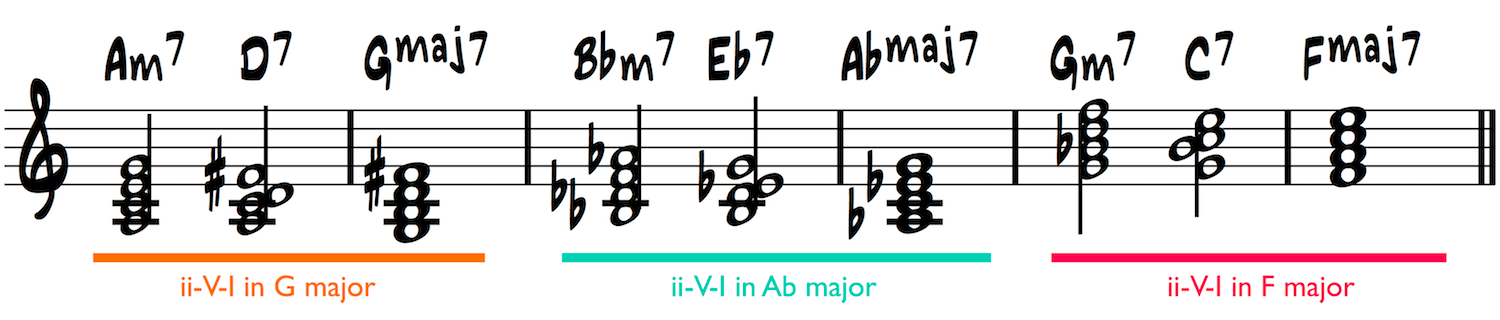
The typical jazz song will change key every few bars, and it will use this ‘2-5-1’ chord progression to do so. You’ll see the same ii-V-I progression played through a series of different keys.
Jazz Piano Left Hand Voicings (How to Play ii–V–I Smoothly)
As a beginner, this how I suggest you play the ii-V-I in your left hand:
Here's a common way to play the ii-V-I in your left-hand:
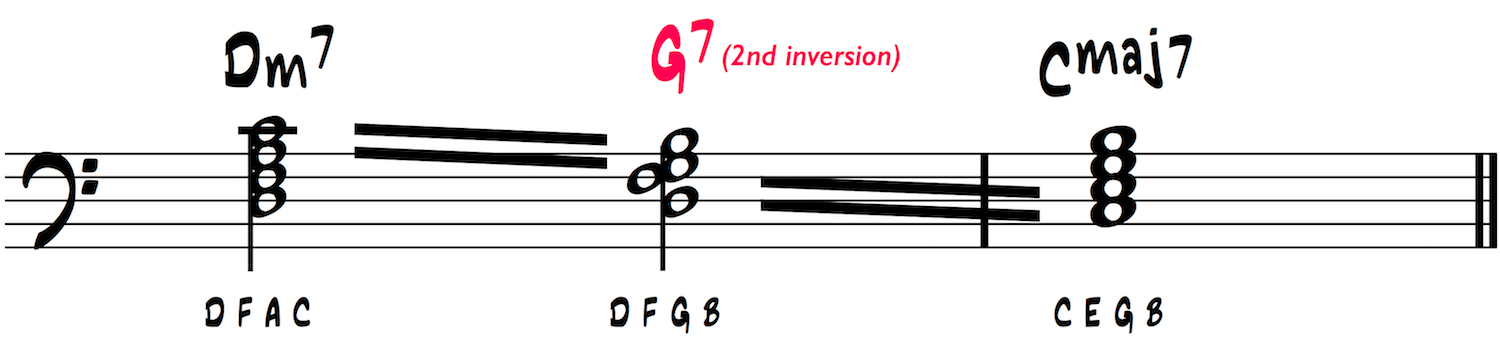
Notice that I'm playing the V7 chord in 2nd inversion - which means I’ve taken the top 2 notes (D and F) and moved them down an octave. This allows you to keep your hand in the same place, while also creating smooth voice leading.
TIP: To play this ii-V-I pattern, all you have to do is build the minor 7 chord first. Then move your top two notes down to the V7 chord’s root and 3rd (G and B) while the bottom notes stay the same (D and F). Finally, move the bottom two notes down to the I chord’s root and 3rd (C and E) while the top notes stay the same (G and B).
PRACTICE CHALLENGE: Learn to play the ii-V-I using this exact voicing pattern through all 12 keys. Challenge yourself to play it note-perfectly through all 12 keys, three times in a row!
Minor ii–V–I Progressions Explained (Jazz Harmony in Minor Keys)
There is also a minor ii-V-I chord progression which is less commonly used (it makes up roughly 10% of the ii-V-Is in your real book).
The minor ii-V-I builds its chords from the harmonic minor scale (instead of the major scale). So a ii-V-I in C minor is built from C harmonic minor scale:

This time the ii chord is a half-diminished chord (Dø), the V chord is a V7 (G7), and the i chord is a min-maj 7 chord (C-Δ).
So when you see a half-diminished chord in a jazz song, it will probably be the ii chord of a minor ii-V-I. And if if you see a minor-major 7 chord, it’s likely the i chord of a minor ii-V-i.
Common ii–V–I Variations
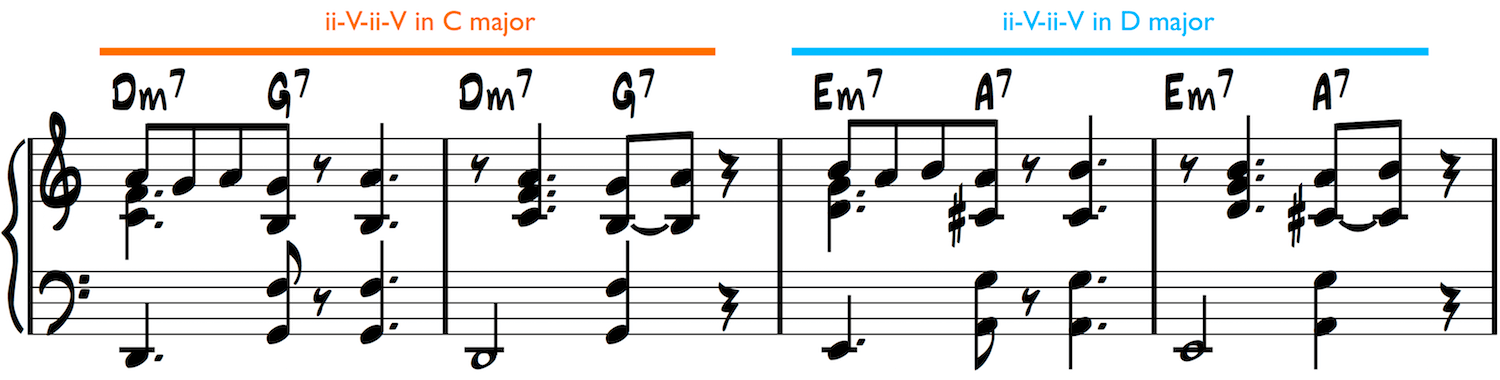
There are also many ‘ii-V-I variations’ that jazz composers will use. Sometimes you’ll see a ‘partial ii-V-I’, where the music plays just a ‘ii-V’ - seen here in Duke Ellington's 'Satin Doll':
And sometimes you'll get a ‘V-I’ - seen here in Benny Goodman's 'Stompin' At The Savoy':
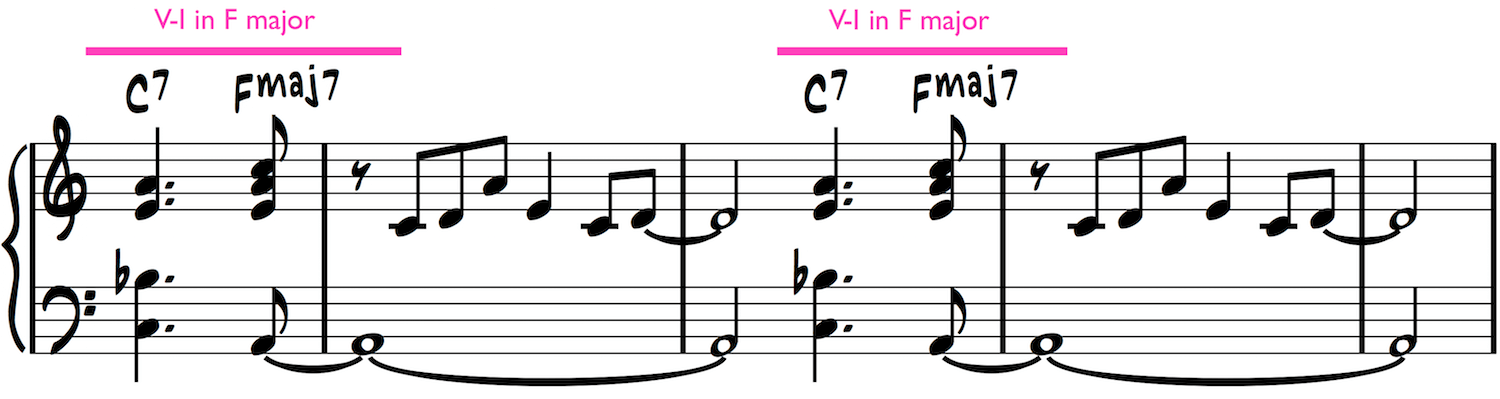
In these 'partial ii-V-I' examples, the song changes to a new key before there's time to play all three chords of the ii-V-I.
To make your chords sound fuller and more professional, you’ll need to understand chord voicings. I break this down step-by-step here:
Jazz Piano Chord Voicings: How to Choose the Right Voicings →
Jazz Piano Improvisation for Beginners (How to Start Soloing)
Here are my top 5 improvisation techniques:
It’s common for Jazz musicians to play an improvised solo over the song’s chords. This usually happens in the middle of the song - in-between the song's melody which is played at the beginning and ending (melody - solos - melody).
To play a solo, you must know which notes to play from. A good place to start is to play the chord tones of each chord in your melody (1 3 5 7) - this technique is called 'chord tone soloing':
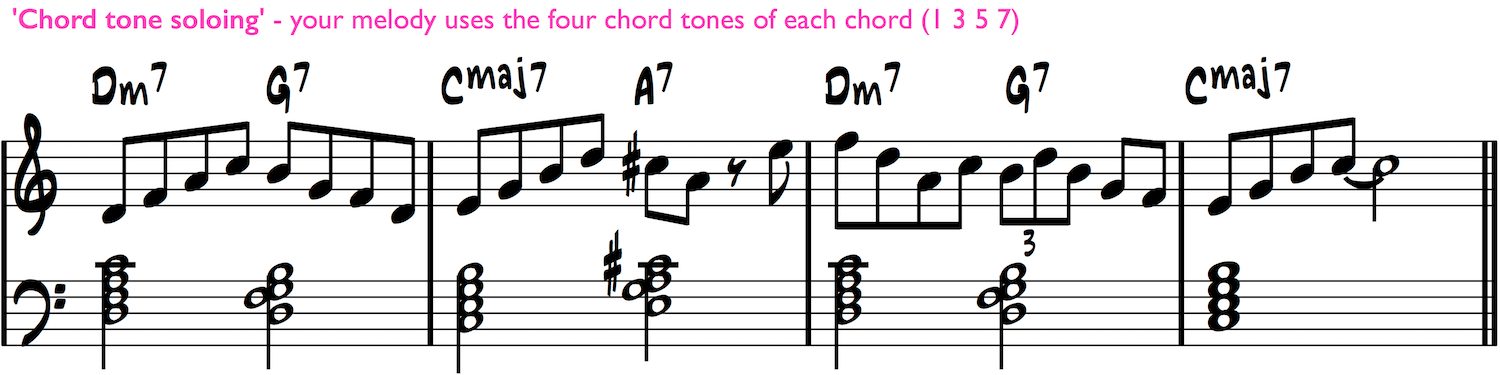
Notice how the melody above is built from the chord tones of each chord (1 3 5 7).
If you want to focus specifically on improvisation and go deeper, start here:
Jazz Piano Improvisation Guide →
Jazz Piano Scales Explained (How to Choose the Right Notes)
In addition to 'chord tone soloing', you can also compose melodies from entire scales. Each type of 7th chord implies a different scale, and it's common for jazz musicians to change scale with every new chord (unlike other styles of music which tend to stay in one key for long periods of time).
"How do you know which scale to play from?"
While there are many scales you can play over each chord, a good starting point is the ‘chord tone + whole-step’ principle:
Start by looking at the chord symbol and putting its chord tones in your scale (1 3 5 7). So for a C major 7 chord, you'd start with C - E - G - B.
Next, add a whole-step above the root, 3rd and 5th. So for C major 7, you'd add D, F# and A to your scale.
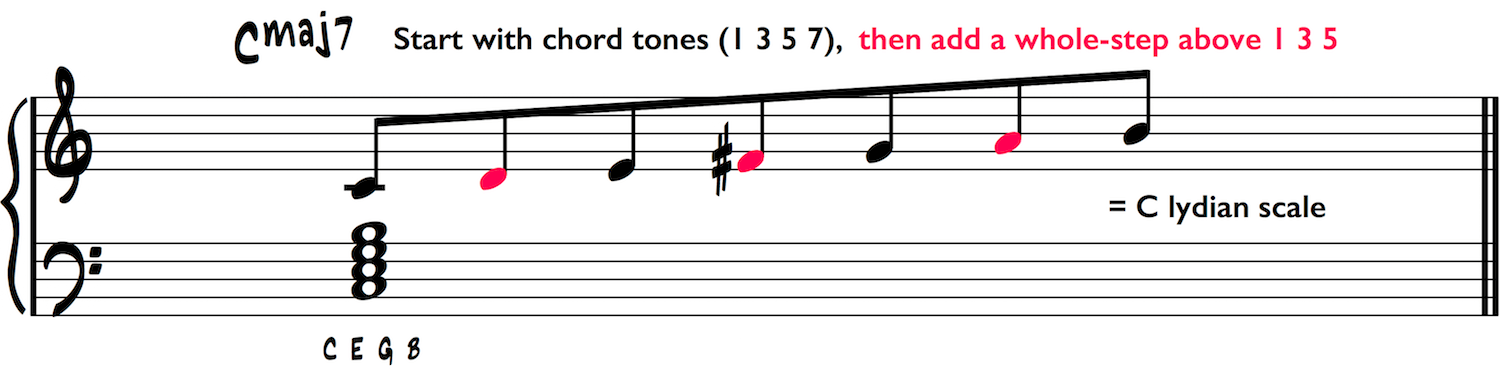
This results in playing C Lydian scale (C D E F# G A B) which sounds great over a C major 7 chord.
You can use this 'chord tone + whole-step' technique for any chord (min 7, V7, ø, etc) and it generates sophisticated-sounding jazz scales every time!
Lesson Summary
Well done — you’ve just covered the core foundations of jazz piano.
In this lesson, you learned:
- How to use fake books to navigate real jazz standards
- The 6 essential 7th chords (maj7, min7, V7, ø, º7, min-Δ)
- How chord extensions (9, 11, 13) create richer harmony
- The ii–V–I progression (major & minor) — the backbone of jazz
- How to improvise using chord tone soloing
- A simple system for jazz scales (“chord tone + whole step”)
These are the exact building blocks used in real jazz playing.
Next Step
1. Jazz Theory Study Guide
Go deeper with my 100-page jazz theory ebook — with clear explanations, exercises, and video lessons.
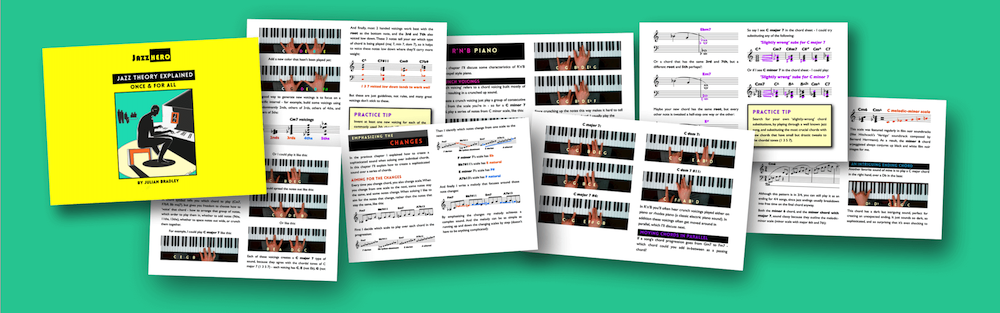
See how the essential chords, scales, voicings, progressions, and improvisation concepts fit together in one place.
2. Free Jazz Piano Starter Pack
Download my most popular jazz piano guides, sheet music, and practice resources.
Related Jazz Piano Guides
Complete Jazz Piano Reference Guide →
Jazz Piano Chord Voicing Guide →
Jazz Piano Fundamentals →
Jazz Piano Improvisation Guide →

I’m Julian Bradley, founder of Jazz Tutorial.
What you get here is one clear teaching philosophy — not a mix of conflicting approaches.
Simple. Structured. No confusion.